
Forge any HR, IT, or Finance automation. Live in one conversation.
The platform where AI Colleagues are built, shipped, and maintained – by describing what you need in plain English (or German!).
Trusted by the industry leading brands



Your AI pilot works.
The business case never does.
Too many handoffs. The pilot never goes live.
- The rules live with the process owner. Everything else lives with someone else.
- Integration, testing and fixes each sit in a different backlog.
- Industry benchmark: 9 to 14 months from demo to production.
One or two automations go live. Then everything stalls.
- Platform knowledge concentrates in one or two people.
- Every new HR, IT and Finance request queues behind them.
- The business case was built on use case ten, not use case two.
Forge does every one of those jobs itself.
Describe the automation once. Forge carries it from pilot to go-live to scale, and nothing ships without your approval.
- No handoffs.Forge connects the systems, writes the tests, and fixes what they catch.
- No bottleneck.Anyone who owns a process can ship one – use case ten moves as fast as use case one.
- No mystery failures.Ask why a run broke and Forge explains it, then repairs it.
Most Agentic AI projects die within 14 months. With Forge you go live in 45 days.
You describe it. Forge plans it.
A sentence in, or your requirements doc. A plan out. You approve.

 Workday Okta Calendar
It builds. Then proves it.
The Colleague, tools, and connections, tested on your real cases. What tests catch, it fixes.
Live, it debugs what it built.
Ask why a run failed. Forge finds the root cause and repairs it, in chat.
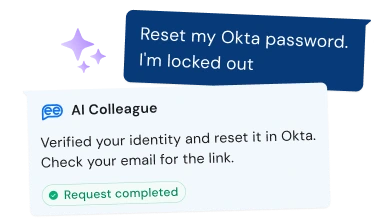
Eight parts make an AI Colleague production-ready. Forge assembles every one.
Built on the same Agentic AI Architecture every Colleague runs on. Each part is an ordinary, editable object.
Describe the work. Forge drafts the AOP.
An AOP reads like your SOP: plain English, steps, owners, approvals. The process owner edits and ships it. No engineering queue.
1,000+ finished tools. Forge builds the rest.
One action per tool: typed, validated, bound at design time. The LLM can’t improvise a call. Missing one? Tell Forge; it ships in minutes.
200+ systems, already wired.
One layer across HRIS, ITSM, ERP, and identity. Forge flags a missing connection before it blocks a step.


Grounded, never copied. And it audits itself.
Permissions inherited from the source. Conflicts and stale content flagged before your people hit them. No cleanup project first.
Every decision kept. Every precedent reused.
Exceptions become precedents: who decided, why, on what conditions. Forge debugs from the same traces.
See every run. Fix it in chat.
Guardrails four layers deep, oversight set per use case. Ask Forge why a run failed. It reads the trace and proposes the patch.

Point Forge at an MCP server. It becomes a step.
Triggers over MCP, A2A, or REST; work hands off to any agent and comes back done. No walled garden.

Runs on events and schedules. 24×7.
A hire lands or month-end opens, and Colleagues start on triggers, pause at approvals, resume with context.
What is Leena AI Forge?
Leena AI Forge is Leena AI's platform for building, testing, running, and fixing AI Colleagues, made for process owners in HR, IT, and Finance – no engineering backlog required. Describe the outcome you want, or hand over a requirements document. Forge plans the work, builds the AI Colleague, the AOPs, the tools and the connections into your systems, tests it, and fixes it when it breaks. One conversation, your approval at each step.
Is Leena AI Forge the same as the AI Colleagues Platform?
Yes. Forge is the new name of the AI Colleagues Platform, and the platform is now agentic. The processes, tools, integrations, knowledge, governance and scheduling that run your AI Colleagues are all still there. What's changed is how you work with them: describe what you want and Forge builds and operates across all of it for you. Everything it makes is a normal object you can open and edit.
Is Forge a separate product or license?
No. Forge is the AI Colleagues Platform – one product, one license. It also comes included with the Universal Assistant. No separate SKU or add-on price.
Many platforms let you describe an agent and get one back. How is Forge different?
Describing the agent is the easy part, and a workflow builder with an LLM bolted on stops there. The real work is in the tools, the connections into your systems, the testing, and the fixing when something breaks. Forge does all of those. Nobody has to work out the APIs, write test cases, or read logs to find out why a run failed.
Can Forge change something in our live systems without approval?
No. Forge sees and does only what the person using it can. Every change is proposed first and waits for approval. It reads from live systems during testing but asks before it changes anything. Nothing it does in a test environment can reach your live one.
How long does it take to put an AI Colleague into production?
43 days on average today, inside the 45 we promise. Two years ago it was 187. The industry benchmark for comparable systems is 9 to 14 months. Forge is how we take that to hours.
What exactly is an AOP (Agent Operating Protocol)?
An AOP is a process graph that mirrors how business teams already think: steps, owners, approvals, SLAs. Each step is filled with a deterministic tool from the registry, and the LLM reasons only inside the rails the AOP defines. Forge writes the first draft from your description. Process owners edit it like an SOP.
AI agents vs. AI Colleagues: what's the difference?
An AI agent runs a task. An AI Colleague owns a process. Agents drift because they invent the workflow on the fly. Colleagues stay on rails: AOPs define the work, tools execute it, and the LLM reasons inside fixed boundaries. Forge builds Colleagues, so what it ships behaves the same way on run one and run one thousand.
How do you prevent hallucinations?
Structured knowledge steps, primary plus evaluator LLMs, positive and negative examples, and a full audit trail. High-risk actions are tool-locked, and each tool knows exactly which fields it can touch. Forge runs test cases from your requirements before anything goes live, so you see failures before your employees do.
What happens when an external system fails mid-run?
Every Colleague run is fully stateful. If an external system fails, times out or returns invalid data, the Colleague can retry, roll back or escalate with prior context intact. Ask Forge why the run failed and it explains the cause in plain language and proposes the fix for your approval.
What does AI governance look like in Forge?
Four layers end to end: LLM fine-tuning, AI Colleague configuration, AOP and execution, and the system prompt. RBAC across Colleagues, AOPs and tools. Source permissions inherited, never re-implemented. Every change runs as the person who asked for it, with a full audit trail.
How are AI Colleagues triggered?
Two ways. Employees and managers can simply ask: Forge builds Employee Self Service (ESS) and Manager Self Service (MSS) use cases too, so a question in the Leena AI universal assistant can start an AI Colleague. Systems can trigger them through REST APIs, MCP and A2A, plus schedules and system events like a new employee landing in the HRMS. Invoke from ITSM tools, HR portals and custom apps – including Workday, ServiceNow, SAP SuccessFactors and Okta – or on a cron. Tell Forge when the work should run and it sets up the triggers.
Is it secure enough for regulated data?
Yes. Built for restricted data (PII/PHI). HIPAA, SOC 2 Type II, ISO/IEC 27001, 27701, 27017, 27018. AES-256-GCM at rest, TLS 1.2+ in transit, AWS KMS-managed keys. Shared public cloud, isolated single-tenant cloud or private VPC across 14+ regions, with tamper-evident audit trails.


